
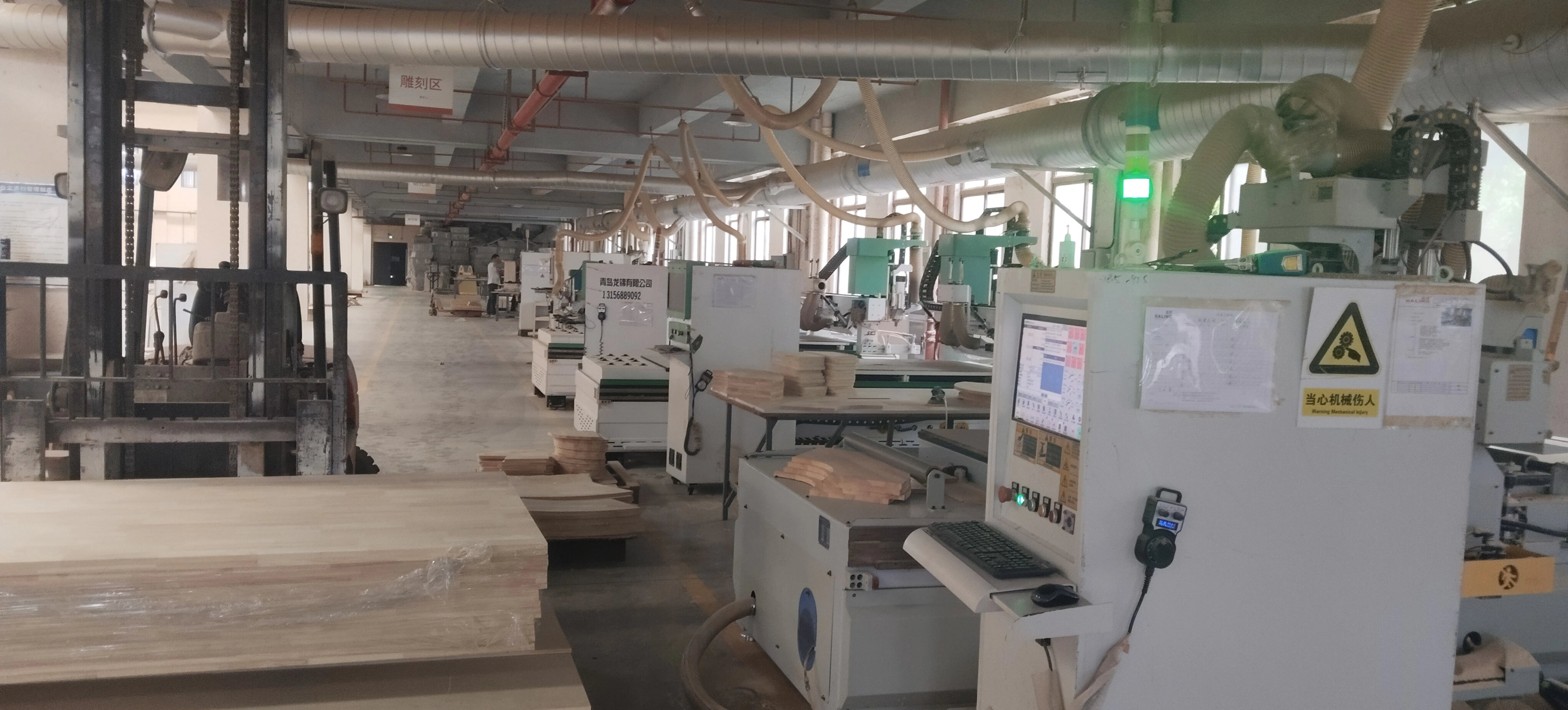
Quality problems in wooden products rarely appear on inspection day. They appear three weeks after arrival, when a mirror frame has bowed, a painted surface has bloomed, or an edge has chipped in transit. By then the goods are in a warehouse on the other side of an ocean, and the cost of the problem has multiplied several times over.
This FAQ covers the quality controls that prevent those outcomes - what to measure, when to measure it, and how to write it down so it is enforceable.
About us: Yunhe Tuoxin Industrial Co., Ltd. produces custom wooden mirrors, wooden toys, small wooden furnishings and handicrafts from Yunhe, Zhejiang, with a second production facility in Shandong. We work to buyer specification packs and support both in-house and third-party inspection.
In this article
- What does good quality mean for a wooden product?
- Which wood and finish defects actually matter?
- Why is moisture content the most expensive variable?
- What does an AQL inspection cover?
- How do I write an inspection plan?
- When should I book third-party inspection?
- How should wooden products be packed for sea freight?
- What should be on the carton and the label?
- How do I handle a batch that fails inspection?
1. What does good quality mean for a wooden product?
For wood, quality is not a single property but a group of properties that fail in different ways. A product can look flawless on arrival and still be a quality failure if it was dried incorrectly, if the joints will open in a dry climate, or if the finish will not survive a season of use. Buyers who specify only appearance tend to discover the rest of the list through claims.
| Dimension | What it means | How it fails late |
|---|---|---|
| Dimensional accuracy | Parts meet the drawing within tolerance | Assembly does not fit on the line; inserts do not align |
| Structural integrity | Joints hold under load and after handling | Joints open, dowels loosen, frames rack |
| Moisture content | Wood dried to the level appropriate for the destination | Shrinkage, warping, cracking after arrival in a drier climate |
| Surface finish | Consistent colour, film thickness, adhesion and smoothness | Flaking, blushing, uneven colour, roughness emerging after handling |
| Material integrity | Correct species, correct grade, free of structural defects | Visible knots, splits and sapwood appearing after finishing |
| Fit and function | Movable parts move, fixed parts stay fixed | Hinges bind, sliders stick, latches misalign |
| Cleanliness | No dust, glue squeeze-out, oil marks or machining residue | Glue lines show through thin finishes; dust appears under lacquer |
Write the quality definition down at golden sample stage. "Same as approved sample" is enforceable only if the approved sample is documented with measurements, not just a photograph. A specification sheet with tolerances turns a subjective argument into a measurement.
2. Which wood and finish defects actually matter?
Not every natural variation in wood is a defect. Knots, grain figure and colour variation are characteristics of a natural material and are often part of the product's appeal. The distinctions worth writing into a specification are those that affect structure, safety or appearance consistency across a production run.
| Defect or variation | Structural risk | Appearance risk | Typical treatment |
|---|---|---|---|
| Large or loose knot | High - can loosen or fall out | High | Reject in structural areas; allow small tight knots in non-structural areas by agreement |
| Split or check | High - propagates under load | High | Reject; often caused by incorrect drying or handling |
| Warp, bow, twist | Medium to high - assembly misaligns | High | Reject beyond an agreed tolerance expressed in millimetres |
| Sapwood inclusion | Low | Medium - takes stain differently | Specify heartwood only where colour consistency matters |
| Grain figure variation | None | Low to medium | Usually accepted; set expectations with buyers |
| Colour variation between parts | None | Medium to high | Specify acceptable range or require colour sorting |
| Glue squeeze-out | Low if cleaned | Medium - shows under thin finishes | Specify cleaning before finishing |
| Machine burn or tear-out | Low | Medium to high | Reject on visible surfaces; specify sanding quality |
| Pin holes and insect damage | High if active | High | Reject; treat as a quarantine and phytosanitary issue |
A practical specification expresses acceptable limits in numbers wherever possible. "No splits longer than 3 mm on visible surfaces" is enforceable. "Good quality wood" is not. The effort of writing tolerances once is repaid the first time a batch is disputed.
3. Why is moisture content the most expensive variable?
Moisture content is the most common root cause of wooden product claims, and it is the one that is hardest to inspect for at the factory gate, because the product can look perfect on the day it is packed and still fail after four weeks in a container and a cold warehouse. Wood is hygroscopic: it gains and loses moisture with the ambient humidity around it, and it changes dimension when it does.
| Destination climate | Typical equilibrium moisture content | Implication for drying target |
|---|---|---|
| Hot and humid (tropical, Gulf) | Higher equilibrium | Less risk of shrinkage cracking; more risk of mould and mildew in transit |
| Temperate and humid (Northern Europe, UK) | Moderate | Standard kiln drying to a moderate target works well |
| Temperate and dry (continental Europe, inland US) | Lower equilibrium | Wood must be dried lower or it will shrink and crack after arrival |
| Hot and dry (desert climates) | Very low equilibrium | The most demanding case; requires the lowest drying target and generous acclimatisation allowance |
| Cold and dry (heated indoor winter) | Low | Interior products such as mirror frames are especially sensitive |
Specify a moisture content range with a destination in mind, not a single number chosen by habit. A frame dried to a target suitable for a humid coastal market will shrink noticeably in a heated European interior, and the gap between the two is measured in millimetres of frame width - enough to open a mitre joint.
Three controls make moisture content manageable: kiln drying to a target matched to the destination, measuring moisture with a calibrated meter on finished parts rather than only on incoming boards, and allowing the wood to acclimatise in the production environment before final machining. Skipping the third step is a common shortcut, and it is the one that produces parts that fit perfectly in the factory and poorly after a sea voyage.
4. What does an AQL inspection cover?
Most importers inspect to an AQL - acceptance quality limit - sampling plan, typically referencing ISO 2859-1. Rather than checking every unit, the inspector draws a defined sample from the batch and compares the number of defects found against an acceptance threshold. The plan is defined by three choices, and those choices determine how strict the inspection is.
| Choice | Common options | Effect |
|---|---|---|
| Inspection level | General I, II or III; special S-1 to S-4 | Higher level means a bigger sample and a stricter inspection |
| AQL for major defects | Commonly 2.5, sometimes 1.5 or 1.0 | Lower AQL means fewer major defects are tolerated |
| AQL for minor defects | Commonly 4.0 | Governs cosmetic issues that do not affect function |
| Defect class | Definition for wooden products | Example |
|---|---|---|
| Critical | Safety hazard, legal non-compliance, or product unusable | Detached small part on a toy; prohibited substance; wrong product in the carton |
| Major | Function affected, or appearance unacceptable on the shelf | Loose joint; misaligned frame; visible finish defect on the front face |
| Minor | Cosmetic only, and would not stop a sale | Faint sanding mark on the underside; slight colour variation on a hidden surface |
Define "critical" explicitly in the inspection plan. Left to interpretation, a critical defect gets reclassified as major during an argument about who pays for rework. Naming the critical categories - safety, compliance, wrong item - removes the ambiguity.
5. How do I write an inspection plan?
An inspection plan is a short document that tells an inspector what to check, how to check it, and what counts as a failure. It does not need to be long; it needs to be specific. A one-page plan with measurable criteria beats a ten-page document of adjectives.
- Reference the approved sample by date, colour code and any signed documentation, so the inspector compares against a fixed standard rather than memory.
- List measurements and tolerances for the dimensions that matter to assembly and function, with the instrument to be used.
- Set the moisture content range and the meter and measurement points to be used.
- Define the colour check - whether it is visual against a colour card, or measured, and under what lighting.
- Describe the finish check - adhesion, film thickness, smoothness, freedom from runs and dust.
- Describe the functional check - what is operated, how many cycles, and what counts as binding or failure.
- Specify packaging checks - insert fit, unit protection, carton strength, labelling, and quantity per carton.
- State the AQL levels for critical, major and minor defects, and what happens if the batch fails.
Send the inspection plan to the supplier before production starts, not with the inspector. A factory that knows the acceptance criteria can self-check during the run and fix problems while the parts are still on the bench. A factory that learns the criteria on inspection day can only negotiate.
6. When should I book third-party inspection?
Third-party inspection is a fixed cost per batch, so it is worth targeting rather than applying to everything. It earns its fee in specific situations, and in others a well-run supplier's own quality system plus a specification pack is a better use of money.
| Situation | Book third-party inspection? | Reasoning |
|---|---|---|
| First order from a new supplier | Yes | Unverified process control; establishes the baseline for the relationship |
| New product with new tooling | Yes | First-article risk is highest on a first production run |
| High-value or high-volume order | Yes | The cost of a failed batch is large relative to the inspection fee |
| Product subject to safety regulation | Yes, plus testing | Inspection does not replace compliance testing, and both are needed |
| Repeat order, stable supplier history | Optional, by sampling | Periodic spot checks are usually sufficient |
| Small trial order | Usually unnecessary | Proportionate cost; a good supplier relationship matters more |
Timing matters as much as whether to inspect. An inspection during production catches problems while they can still be corrected on the line. A pre-shipment inspection catches them when the only options are rework under time pressure or a postponed shipment. Where the order value justifies it, book both.
7. How should wooden products be packed for sea freight?
Packaging for wooden products has one job beyond presentation: to deliver a product that arrives in retail condition after weeks in a container, where temperatures cycle and humidity can sit high for long periods. Most transit damage on wooden goods traces back to movement inside the carton, moisture, or stacking load.
| Risk | Cause | Control |
|---|---|---|
| Surface abrasion | Product moving against the carton or another unit | Custom insert or wrap; no loose fit inside the carton |
| Corner and edge damage | Stacking load and handling impacts | Corner protectors; adequate carton board grade; respect the stacking limit |
| Moisture and mould | Container humidity during long sea voyages | Desiccant where needed; avoid packing damp product; consider container desiccant bags |
| Warping | Moisture cycling acting on unrestrained parts | Pack flat and restrained; correct drying before packing |
| Chemical transfer | Inks, tapes or foam reacting with the finish | Barrier layer between the product and printed surfaces |
| Hardware damage | Protruding fixings pressing into the neighbouring unit | Insert channels; separate compartments in the insert |
Ask for a carton drop and stacking test result if the product is heavy or fragile. It is a cheap test relative to a container of damaged goods, and it forces a conversation about board grade and insert design while there is still time to change them.
8. What should be on the carton and the label?
Carton marking is a small part of the specification that causes a disproportionate amount of warehouse and customs friction when it is wrong. Confirm the marking layout as part of the specification pack, and check it on the pre-production sample rather than after the cartons are printed.
| Element | Purpose | Common mistake |
|---|---|---|
| Buyer and supplier names | Identification through the chain | Trading company name used inconsistently across documents |
| PO number and item code | Reconciliation on receipt | Missing PO number forcing manual identification |
| Quantity per carton | Counting and receiving | Inner and master carton counts that do not match the packing list |
| Carton number and total | Traceability and short-shipment detection | Numbering that resets across pallets |
| Gross and net weight | Handling, freight and documentation | Estimated rather than measured weights |
| Dimensions | Freight calculation and storage planning | Dimensions taken from the drawing rather than the packed carton |
| Country of origin | Customs and labelling compliance | Marking inconsistent with the commercial invoice |
| Handling symbols | Protection in transit | Symbols printed but not respected by the loading plan |
If the destination market requires retail-ready packaging with specific labelling, treat that as part of the compliance file rather than a packaging detail. Retailer labelling requirements are specific and are checked; a late label change is one of the few things that can hold a shipment after production is complete.
9. How do I handle a batch that fails inspection?
A failed inspection is a process event, not a crisis, provided the specification defined what failure means and the parties agreed in advance what happens next. The outcomes that go badly are the ones where the acceptance criteria were vague and the remedy was never discussed.
| Failure type | Typical remedy | Who bears the cost |
|---|---|---|
| Critical defect | Reject the batch; rework or reproduce | Supplier, if it is a production fault rather than a specification error |
| Major defect beyond the AQL | Rework and re-inspect, or negotiate a reduced price if acceptable | Supplier, unless the buyer changed the specification after sampling |
| Minor defect beyond the AQL | Negotiate; often accepted with a price adjustment | Negotiated |
| Specification error discovered at inspection | Amend the specification; decide whether the goods are acceptable as built | Buyer, unless the supplier should have flagged the issue earlier |
| Damage caused by packing or loading | Claim against the party responsible for that stage | Depends on the Incoterm and where risk transferred |
The strongest protection against a contested claim is not a contract clause - it is the golden sample plus a written specification with tolerances plus inspection reports from the production stage. Those three together let both sides agree on what was promised and what was delivered, which is usually the only real dispute. Where a claim is unavoidable, resolve it against the next order rather than in isolation, because that keeps the schedule and the relationship intact and is generally the cheapest outcome for both parties.
Want a quality plan built around your product?
Send us your specification and destination market. We will propose tolerances, drying targets, inspection criteria and packaging that fit the product and the route.
Related reading on this site
Related reading on this site
See the compliance and sourcing sides of the same programme.